
Europa League Highlights: Aubameyang’s Record, the 2026/27 Draw and How to Watch
Pierre-Emerick Aubameyang is the Europa League’s all-time top scorer, Juventus and AC Milan are both in this season’s draw, and here’s where to catch every highlight.
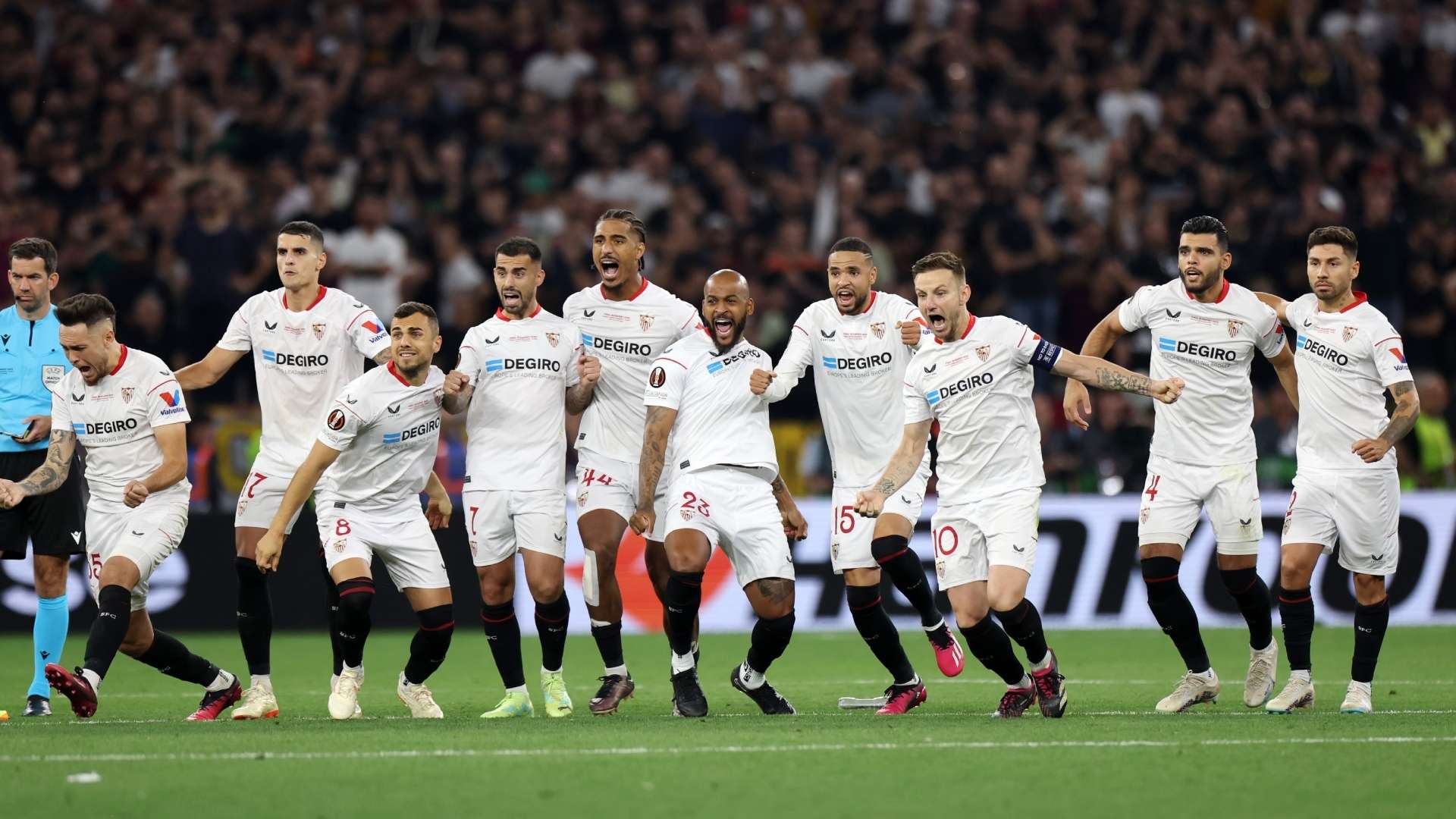
Sevilla have won the Europa League a record seven times without ever losing a final. Here's the complete list of champions since 1971/72.
No club has ever dominated the Europa League quite like Sevilla, winners a record seven times without ever losing a final. Aston Villa are the reigning champions after beating Freiburg 3-0 in Istanbul in May 2026, their first European trophy in 44 years. Below is the complete list of champions going back to the competition's first edition in 1971/72 as the UEFA Cup, plus the clubs who have won it more than once and the stories behind the biggest upsets.
The competition has run continuously since 1971/72, first as the UEFA Cup, then as the UEFA Europa League from 2009/10 onward. Here is every champion.
| Season | Winner |
|---|---|
| 1971/72 | Tottenham Hotspur |
| 1972/73 | Liverpool |
| 1973/74 | Feyenoord |
| 1974/75 | Borussia Mönchengladbach |
| 1975/76 | Liverpool |
| 1976/77 | Juventus |
| 1977/78 | PSV Eindhoven |
| 1978/79 | Borussia Mönchengladbach |
| 1979/80 | Eintracht Frankfurt |
| 1980/81 | Ipswich Town |
| 1981/82 | IFK Göteborg |
| 1982/83 | Anderlecht |
| 1983/84 | Tottenham Hotspur |
| 1984/85 | Real Madrid |
| 1985/86 | Real Madrid |
| 1986/87 | IFK Göteborg |
| 1987/88 | Bayer Leverkusen |
| 1988/89 | Napoli |
| 1989/90 | Juventus |
| 1990/91 | Inter Milan |
| 1991/92 | Ajax |
| 1992/93 | Juventus |
| 1993/94 | Inter Milan |
| 1994/95 | Parma |
| 1995/96 | Bayern Munich |
| 1996/97 | Schalke 04 |
| 1997/98 | Inter Milan |
| 1998/99 | Parma |
| 1999/2000 | Galatasaray |
| 2000/01 | Liverpool |
| 2001/02 | Feyenoord |
| 2002/03 | Porto |
| 2003/04 | Valencia |
| 2004/05 | CSKA Moscow |
| 2005/06 | Sevilla |
| 2006/07 | Sevilla |
| 2007/08 | Zenit Saint Petersburg |
| 2008/09 | Shakhtar Donetsk |
| 2009/10 | Atlético Madrid |
| 2010/11 | Porto |
| 2011/12 | Atlético Madrid |
| 2012/13 | Chelsea |
| 2013/14 | Sevilla |
| 2014/15 | Sevilla |
| 2015/16 | Sevilla |
| 2016/17 | Manchester United |
| 2017/18 | Atlético Madrid |
| 2018/19 | Chelsea |
| 2019/20 | Sevilla |
| 2020/21 | Villarreal |
| 2021/22 | Eintracht Frankfurt |
| 2022/23 | Sevilla |
| 2023/24 | Atalanta |
| 2024/25 | Tottenham Hotspur |
| 2025/26 | Aston Villa |
Sevilla are, by a wide margin, the most successful club in the history of this competition. They have reached seven Europa League finals and won all seven, a perfect record that no other club has come close to matching. Their run started in 2006 with a 4-0 win over Middlesbrough, and it picked up serious momentum between 2014 and 2016, when they won three straight titles, a feat unmatched by any other club in the competition's history. Their most recent triumph came in 2023, beating Jose Mourinho's Roma 4-1 on penalties after a tense 1-1 draw at the Puskás Aréna in Budapest.
What makes Sevilla's record so unusual is how it has survived constant turnover. Players, coaches and sporting directors have all come and gone across nearly two decades, while the club's league form in La Liga has fluctuated between solid mid-table finishes and occasional relegation battles. Somehow none of that has ever affected their level in this specific competition. Sevilla have essentially built an entire modern institutional identity around treating a competition many bigger clubs see as a consolation prize as their primary source of silverware and continental prestige.
Behind Sevilla, five clubs share the next tier with three titles apiece: Inter Milan, Tottenham Hotspur, Liverpool, Juventus and Atlético Madrid.
One name that surprises a lot of casual fans: Real Madrid, a club almost synonymous with the European Cup and Champions League, actually won this competition back to back in 1985 and 1986, in an era before their modern European Cup dominance really took hold.
Across the 55 finals played since 1971/72, 31 different clubs have had their name engraved on the trophy. Only 13 of those clubs have ever managed to win it more than once. That leaves 18 clubs, including Ipswich Town, Galatasaray, Valencia, Villarreal and Atalanta, with exactly one triumph each, a single standalone European trophy that has never been repeated. It is a genuinely open competition by the standards of continental football, far more so than the Champions League, where a much smaller group of clubs has monopolized the trophy for most of its history.
Parma are one of the more surprising names to show up twice on the winners list, having won in both 1995 and 1999. Those titles came during the club's remarkable financial peak in the 1990s, a period when a provincial Italian club with no historic pedigree briefly operated as one of the biggest spenders in European football and reached multiple European finals across several competitions. Parma's Europa League record is a reminder of how quickly a club's European fortunes can rise, and, in Parma's case, how far they can eventually fall: the club went through bankruptcy and a rebuild from Italy's lower divisions within about two decades of their second UEFA Cup win.
The competition launched in 1971/72 as the UEFA Cup, originally designed for clubs that had just missed out on qualifying for the European Cup or the old Cup Winners' Cup. When the Cup Winners' Cup was scrapped in 1999, its remaining places were folded into the UEFA Cup, and in 2009 UEFA rebranded the whole thing as the Europa League and introduced a group stage for the first time, giving it a format closer to the Champions League's. The names on the trophy did not change, only the branding around them, which is why this list treats both eras as one continuous history rather than splitting it in two.
Aston Villa's 2025/26 title, sealed with a 3-0 win over Freiburg at Istanbul's Şükrü Saracoğlu Stadium, was the club's first European trophy since they won the old European Cup back in 1981/82, a gap of 44 years. It capped a remarkable rebuild that took Villa from England's second tier as recently as 2019 to genuine European contenders under Unai Emery.
The final before that, in 2024/25, saw Tottenham beat Manchester United 1-0 in Bilbao. It was notable for two reasons at once: it was Spurs' first major trophy of any kind in 17 years, and it doubled as their route back into the following season's Champions League after they had finished a disappointing 17th in the Premier League that year. For United, the defeat capped one of the worst Premier League campaigns in the club's history, making the final loss sting even more than it otherwise would have.
Not every name on this list is a European giant. Ipswich Town won the competition in 1981, a genuine shock even by the standards of an era when English clubs were regularly among Europe's best. IFK Göteborg won it twice, in 1982 and 1987, remarkable achievements for a Swedish club operating with none of the financial advantages of the competition's bigger names. Galatasaray's win in 2000 remains Turkish football's only European trophy at club level. CSKA Moscow in 2005 and Zenit Saint Petersburg in 2008 both brought the trophy to Russia during a period when Russian clubs were investing heavily in European competition, and Shakhtar Donetsk's win in 2009 stands as one of Ukrainian football's proudest continental achievements. More recently, Villarreal's win in 2021, on penalties against Manchester United in Gdańsk, showed that a mid-sized Spanish club could still go all the way even in the competition's modern, more standardized format.
For a full breakdown of how the competition works today, including the league phase and knockout format shared with the Champions League and Conference League, read our Europa League format explained guide. For the individual scoring record rather than the club history, see our Europa League all-time top scorers list, led by Pierre-Emerick Aubameyang. And for this season's action, visit our Europa League highlights hub.
Sevilla, with seven titles: 2006, 2007, 2014, 2015, 2016, 2020 and 2023. They have reached seven finals and won every single one.
Aston Villa, beating Freiburg 3-0 in the final in Istanbul on May 20, 2026, their first European trophy since 1981.
Tottenham Hotspur won the competition's first edition in 1971/72, the first of their three titles in the competition's history.
Yes, twice, back to back in 1985 and 1986, despite the club being far more strongly associated with the European Cup and Champions League.
Inter Milan, Tottenham Hotspur, Liverpool, Juventus and Atlético Madrid have all won it three times each, behind only Sevilla's seven.
Yes. UEFA rebranded the UEFA Cup as the Europa League ahead of the 2009/10 season and added a group stage, but it is the same continuous competition, which is why winners from both eras appear on the same all-time list.

Pierre-Emerick Aubameyang is the Europa League’s all-time top scorer, Juventus and AC Milan are both in this season’s draw, and here’s where to catch every highlight.

Every fixture from the 2026/27 Europa League league phase draw in Monaco: all four pots, all 36 clubs, and the biggest matchups to watch.

Pierre-Emerick Aubameyang leads the Europa League's all-time scoring chart with 34 goals. Here's the full top five and who could still climb it.

The Europa League uses the same 36-team Swiss model as the Champions League. Here is how the league phase and knockouts work.
Get the latest blog posts delivered to your inbox